
Sport is a vital part of healthy childhood development. Regular participation improves strength, coordination, cardiovascular fitness and psychological well-being. It also builds resilience and teamwork skills. However, children are not physiologically identical to adults. Their bones, joints and soft tissues are still developing, which alters how force is absorbed and how sports injuries occur. Addressing symptoms as soon as they appear, and identifying the source of strain or injury, improves recovery outcomes and protects future joint and bone development.
Common Symptoms of Sports Injuries in Children
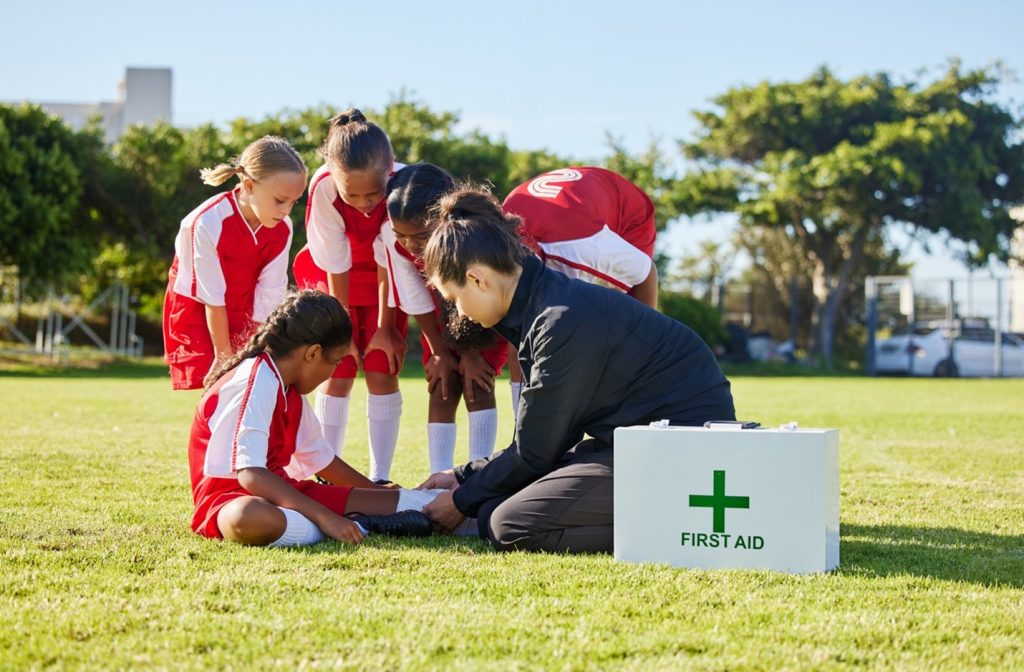
Children may not always report pain immediately, particularly if they are eager to continue playing. Parents and coaches should therefore watch for both behavioural and physical signs.
Pain at a specific site that worsens with running, jumping or throwing is one of the earliest indicators. Swelling, redness and bruising may develop after a fall or collision. A child who begins limping, avoids using one arm, or refuses to bear weight requires careful evaluation.
Restricted movement is another warning sign. Difficulty bending a knee, lifting an arm, or rotating the neck can indicate structural injury rather than simple muscle soreness. Tenderness when a specific area is pressed, especially over bone, suggests possible fracture or growth-related irritation.
Joint instability, visible deformity or abnormal alignment should prompt urgent medical assessment. Neurological symptoms, including numbness, tingling or weakness, are not typical of minor sprains and require prompt review.
Head injuries present differently. Persistent headache, dizziness, confusion, nausea, blurred vision or sensitivity to light and noise can indicate a concussion. Any suspected head injury should be assessed before return to sport.
A consistent red flag is pain that alters behaviour. If a child wakes at night due to discomfort, withdraws from activity, or demonstrates declining performance, symptoms should not be dismissed as routine post-exercise soreness.
Frequent Types of Sports Injuries
Sprains and strains are common in field and court sports. An ankle sprain often occurs during a sudden directional change and presents with swelling and pain around the outer ankle. Muscle strains may follow overstretching or rapid acceleration.
Knee injuries are also frequent, particularly in sports requiring pivoting. Ligament injuries can present with swelling, instability or a sensation of the knee giving way. In adolescents, more significant ligament disruption may occur in high-demand sports.
Overuse conditions are particularly relevant in growing athletes. Repetitive traction at tendon attachment sites can lead to localised pain around the knee or heel. Lower leg pain from repetitive impact, often described as shin discomfort during running, is also common.
Stress fractures present with gradually increasing pain that worsens during activity and improves with rest. Unlike acute fractures, swelling may be minimal initially. Persistent back pain, especially in sports involving repetitive extension, such as gymnastics, may indicate stress injury to the posterior elements of the spine.
Growth and Developmental Factors
The immature skeleton contains specialised growth centres composed of cartilage. These areas enable bone lengthening but are more susceptible to injury than mature bone. During twisting trauma, force may transmit through these regions rather than through ligaments.
Growth spurts introduce a temporary imbalance. Bones lengthen rapidly while muscles and tendons adjust more slowly. Reduced flexibility increases traction stress at attachment sites, particularly around the knee and heel.
Neuromuscular control continues to mature throughout adolescence. During rapid growth, coordination may temporarily decline, increasing the likelihood of awkward landings. Younger athletes may also lack the strength and control required to stabilise joints during high velocity movement.
Overuse and Training-Related Causes
Repetitive mechanical load without adequate recovery is a major contributor to injury in children. Year-round participation in a single sport exposes the same joints to repeated stress. Insufficient rest days limit tissue repair.
A sudden rise in training volume or intensity can exceed the adaptive capacity of growing bone and cartilage. Excessive numbers of matches or tournaments within short periods amplify cumulative strain.
Poor technique increases stress on vulnerable structures. Inadequate hip strength can elevate knee loading. Suboptimal shoulder mechanics during throwing may overload the elbow. These biomechanical factors are modifiable with appropriate coaching and conditioning.
Equipment and Conditioning Issues
Lack of a structured warm-up reduces muscle readiness and joint control. Inadequate conditioning increases fatigue, and fatigue impairs landing mechanics. Ill-fitting footwear or protective equipment can compromise stability and amplify impact forces.
Children who increase activity suddenly after a sedentary period are at greater risk. Similarly, pushing through pain or ignoring early symptoms prolongs recovery and increases the likelihood of chronic problems.
Environmental and Sport-Specific Risks
Playing surfaces influence injury risk. Uneven ground increases ankle inversion injuries. Hard surfaces amplify repetitive impact forces through the lower limb. Poor lighting may contribute to falls or collisions.
Contact sports carry additional collision risk, while sports involving repetitive spinal extension may predispose to stress-related back conditions. Running-based sports commonly produce heel and lower leg pain due to repetitive load transmission.
Why Children’s Injuries Differ from Adults
In adults, ligaments are frequently the weakest link during trauma. In children, growth centres may fail before ligaments tear. Accurate diagnosis is therefore essential to prevent disturbance of bone development.
Children may tolerate pain differently and underreport symptoms. Enthusiasm for participation can mask severity, delaying appropriate assessment. When identified early, most paediatric sports injuries respond well to conservative management. Delayed intervention may prolong absence from sport and affect long-term joint health.
When to Seek Specialist Assessment
Immediate medical evaluation is necessary for visible deformity, inability to bear weight, significant swelling or suspected fracture.
Specialist review is recommended if pain persists beyond several days despite rest, recurs upon return to activity, or interferes with performance: night pain, neurological symptoms or repeated injury to the same joint warrant further investigation.
A structured management plan that includes accurate diagnosis, supervised rehabilitation, and graded return to play supports both physical recovery and psychological confidence.
Conclusion
Sports participation remains strongly encouraged in childhood due to its physical and psychological benefits. Injury risk can be minimised through education, appropriate training progression, adequate rest and early recognition of warning signs. Persistent or localised pain in a growing child is not a normal part of sport. Timely assessment protects growth centres, preserves joint integrity and enables safe return to activity. With informed supervision and evidence-based care, most young athletes recover fully and continue to benefit from lifelong physical activity.