
Written by: Editorial Team, Bangalore Shoulder Institute
Medically Reviewed by: Dr. Ayyappan V. Nair
Senior Consultant – Shoulder Surgery, Arthroscopy and Sports Trauma
Manipal Hospitals, Bangalore
Last Reviewed: 15th November 2026
Introduction
Overhead throwing places substantial demands on the shoulder, requiring a precise balance between mobility, stability, strength, and neuromuscular control. Athletes participating in baseball, cricket, volleyball, tennis, and other overhead sports are exposed to repetitive loading that may contribute to shoulder pain and dysfunction.
The throwing motion involves coordinated activation of the rotator cuff, scapular stabilizers, glenohumeral ligaments, labrum, and muscles of the kinetic chain. Repetitive high-velocity throwing can produce adaptive changes in these structures, but excessive loading or inadequate recovery may lead to pathological changes.
Throwing-related shoulder injuries encompass a spectrum of conditions, including rotator cuff tendinopathy and tears, superior labral anterior-to-posterior (SLAP) lesions, biceps tendinopathy, internal impingement, glenohumeral microinstability, glenohumeral internal rotation deficit (GIRD), and scapular dyskinesis.
Early identification of the underlying pathology, appropriate rehabilitation, and individualized treatment are essential to restore function and facilitate a safe return to sport.
Common Throwing Injuries of the Shoulder
1. Rotator Cuff Tendinopathy and Tears
The rotator cuff consists of four muscles—supraspinatus, infraspinatus, teres minor, and subscapularis—that contribute to dynamic glenohumeral stability and controlled shoulder movement.
During throwing, the rotator cuff plays a critical role in controlling humeral head translation and decelerating the arm following ball release. Repetitive loading can produce tendon irritation, tendinopathy, and partial-thickness tears.
In overhead athletes, rotator cuff injuries frequently involve the articular surface of the posterior supraspinatus and anterior infraspinatus, particularly in association with internal impingement.
Symptoms
- Shoulder pain during throwing, particularly during late cocking or acceleration.
- Pain during arm elevation and lowering.
- Weakness or reduced throwing velocity.
- Pain during or after sporting activity.
- Difficulty performing overhead activities.
Treatment Modalities
Conservative management
- Relative rest and modification of throwing workload.
- Short-term analgesics or NSAIDs when indicated.
- Progressive rotator cuff strengthening.
- Scapular stabilization and kinetic-chain rehabilitation.
- Correction of relevant mobility deficits and throwing mechanics.
Surgical management
Surgery may be considered for selected athletes with persistent symptoms and structurally significant tears despite appropriate rehabilitation.
Procedures may include arthroscopic debridement of selected partial-thickness tears, rotator cuff repair for appropriate tear patterns, and treatment of associated labral or impingement pathology when clinically indicated.
Subacromial decompression should not be considered a routine treatment for every throwing-related rotator cuff disorder; the procedure must be justified by the specific underlying pathology.
2. Superior Labral Anterior-to-Posterior (SLAP) Tears
A SLAP lesion involves the superior glenoid labrum, extending from anterior to posterior relative to the attachment of the long head of the biceps tendon.
During throwing, repetitive torsional forces transmitted through the biceps-labral complex may contribute to superior labral injury. The peel-back mechanism, particularly during late cocking, is an important proposed mechanism of SLAP lesion development.
However, superior labral abnormalities may also represent adaptive changes and can be present in asymptomatic athletes. Clinical correlation is therefore essential before attributing symptoms to an imaging abnormality.
Symptoms
- Deep shoulder pain during throwing.
- Clicking, catching, or popping sensations.
- Reduced throwing performance or velocity.
- Pain during late cocking or acceleration.
- Discomfort during overhead activities.
Treatment Modalities
Conservative management
Initial treatment generally includes activity modification and a structured rehabilitation program addressing posterior shoulder mobility, rotator cuff strength, scapular control, and kinetic-chain function.
Surgical management
Surgery may be considered when symptoms persist despite appropriate nonoperative treatment and the lesion is judged to be clinically significant.
Options include:
- Arthroscopic SLAP repair using suture anchors in appropriately selected athletes.
- Biceps tenodesis in selected patients, depending on age, activity demands, biceps pathology, and lesion characteristics.
- Debridement for selected unstable or frayed labral tissue without a repairable unstable lesion.
The choice between SLAP repair and biceps tenodesis requires particular care in high-level throwing athletes because postoperative stiffness or altered glenohumeral mechanics may compromise throwing performance.
What Recent Research Says
A critical review of common upper-extremity injuries in throwing athletes emphasizes that surgery involving the labrum, rotator cuff, or other stabilizing structures may cause scarring, stiffness, or excessive tightening, potentially affecting athletic performance.
The authors recommend exhausting appropriate nonoperative treatment before considering surgery in most throwing athletes.
Reference:
Management of Common Upper Extremity Injuries in Throwing Athletes: A Critical Review of Current Outcomes.
- Journal of Experimental Orthopaedics.
3. Long Head of the Biceps Tendinopathy and Tendon Tears
The long head of the biceps tendon originates from the superior glenoid labrum and supraglenoid tubercle. It contributes to the biceps-labral complex and may become symptomatic in athletes exposed to repetitive overhead loading.
Biceps tendinopathy can occur independently or in association with SLAP lesions, rotator cuff pathology, and internal impingement.
Progressive tendon degeneration may occasionally result in partial or complete rupture.
Symptoms
- Anterior shoulder pain.
- Tenderness over the bicipital groove.
- Pain during overhead throwing.
- Discomfort during resisted elbow flexion or forearm supination.
- A sudden painful pop or change in upper-arm contour in the event of tendon rupture.
Treatment Modalities
Conservative management
- Modification of provocative activities.
- Progressive rehabilitation of the shoulder and kinetic chain.
- Treatment of associated rotator cuff or labral pathology.
- Gradual restoration of throwing tolerance.
Surgical management
For appropriately selected patients with persistent, functionally significant biceps pathology, surgical options may include arthroscopic tenodesis or other procedures directed at the associated pathology.
Biceps tenodesis is not indicated for every throwing-related biceps or labral abnormality. Treatment should reflect the athlete’s age, performance demands, clinical findings, and response to rehabilitation.
4. Internal Impingement
Internal impingement is a recognized cause of posterior shoulder pain in overhead athletes. It typically occurs when the arm is abducted and externally rotated during the late cocking phase of throwing.
In this position, the articular surface of the posterior rotator cuff may contact the posterosuperior glenoid and labrum.
Although a degree of contact may occur physiologically in throwers, repetitive excessive loading can be associated with articular-sided rotator cuff tears, posterosuperior labral pathology, and symptomatic shoulder dysfunction.
Symptoms
- Posterior shoulder pain during late cocking.
- Reduced throwing velocity.
- Decreased throwing endurance.
- Loss of internal rotation.
- Associated rotator cuff or labral symptoms.
Treatment Modalities
Conservative management
Rehabilitation focuses on:
- Posterior shoulder mobility.
- Correction of clinically significant GIRD.
- Rotator cuff strengthening.
- Scapular stabilization.
- Core and lower-extremity conditioning.
- Throwing-mechanics assessment and workload modification.
Surgical management
Surgery is reserved for carefully selected patients who remain symptomatic despite appropriate rehabilitation.
Depending on the pathology, procedures may include selective debridement of unstable posterosuperior labral tissue, treatment of relevant rotator cuff tears, or correction of a clearly identified structural abnormality.
Surgical treatment should avoid unnecessary loss of external rotation, which is essential for high-level throwing performance.
5. Glenohumeral Instability and Microinstability
Throwing athletes require considerable shoulder mobility to generate high angular velocities. Physiological adaptations, including increased external rotation and altered capsuloligamentous laxity, may contribute to throwing performance.
However, repetitive microtrauma can produce symptomatic microinstability, in which the humeral head does not remain adequately controlled during high-demand movements.
Unlike traumatic instability, which may present with an obvious dislocation or subluxation, microinstability in throwers often develops gradually.
Symptoms
- Shoulder pain during throwing.
- A sensation of looseness or loss of control.
- Decreased throwing velocity.
- Arm fatigue or a subjective dead-arm sensation.
- Reduced performance without an obvious traumatic event.
Treatment Modalities
Conservative management
Initial management generally involves:
- Activity and workload modification.
- Rotator cuff strengthening.
- Scapular stabilization.
- Neuromuscular control exercises.
- Correction of relevant kinetic-chain deficits.
- Progressive return to throwing.
Surgical management
Arthroscopic stabilization may be considered when a defined structural instability lesion persists despite appropriate nonoperative management.
The procedure should be tailored to the specific pathology. Excessive capsular tightening or restriction of external rotation can compromise the performance of throwing athletes.
What Recent Research Says
Thacher and colleagues reviewed current concepts in the management of shoulder instability in throwing athletes.
Their review emphasizes that subtle microinstability caused by repetitive microtrauma is common in this population and that individualized rehabilitation should generally precede surgical stabilization.
The authors also highlight the importance of avoiding excessive tightening of the glenohumeral joint.
Reference:
Thacher RR, Varady NH, Khilnani T, Camp CL, Dines JS. Current Concepts on the Management of Shoulder Instability in Throwing Athletes. Current Reviews in Musculoskeletal Medicine. 2024;17:353–364.
DOI: 10.1007/s12178-024-09910-1
6. Glenohumeral Internal Rotation Deficit (GIRD)
GIRD describes a reduction in glenohumeral internal rotation, typically assessed by comparing the throwing shoulder with the contralateral shoulder.
Repeated throwing can produce adaptations involving the posterior shoulder capsule, posterior rotator cuff, and humeral and glenoid morphology.
However, not every internal rotation deficit is pathological. Some throwers develop a compensatory increase in external rotation, and the clinical significance of GIRD depends on the overall rotational arc, symptoms, and associated movement abnormalities.
Pathological GIRD may contribute to altered shoulder mechanics and is associated with internal impingement in some athletes.
Symptoms and Clinical Findings
- Reduced internal rotation of the throwing shoulder.
- Posterior shoulder tightness.
- Pain during late cocking.
- Altered total rotational arc.
- Associated scapular dyskinesis or internal impingement.
Treatment Modalities
Treatment should be directed toward the underlying cause and may include:
- Posterior shoulder stretching when appropriate.
- Cross-body adduction stretching.
- Sleeper stretching in selected patients.
- Rotator cuff and scapular strengthening.
- Correction of throwing mechanics.
- Progressive workload management.
Stretching should be individualized because aggressive attempts to normalize internal rotation may be inappropriate when the deficit reflects bony adaptation rather than posterior soft-tissue restriction.
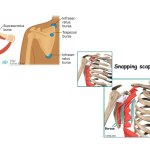
7. Scapular Dyskinesis and SICK Scapula
The scapula provides a stable platform for glenohumeral movement and contributes to efficient force transfer throughout the throwing kinetic chain.
Scapular dyskinesis refers to altered scapular movement or positioning. It may occur in association with muscular fatigue, weakness, restricted mobility, or changes in the mechanics of the thorax and upper extremity.
The term SICK scapula describes a clinical pattern involving scapular malposition, inferior medial border prominence, coracoid pain or malposition, and dyskinesis.
These findings may be relevant in symptomatic throwers, although scapular dyskinesis can also occur in asymptomatic athletes.
Symptoms and Clinical Findings
- Altered scapular position or movement.
- Prominence of the medial scapular border.
- Anterior shoulder or coracoid-region pain.
- Periscapular muscle fatigue.
- Reduced throwing endurance.
- Associated rotator cuff or shoulder pain.
Treatment Modalities
Treatment generally focuses on correcting clinically relevant movement and strength deficits through:
- Serratus anterior and trapezius strengthening.
- Scapular control and stabilization exercises.
- Pectoralis minor stretching when indicated.
- Thoracic mobility exercises.
- Core and kinetic-chain conditioning.
- Correction of throwing mechanics and excessive workload.
Surgery is rarely indicated for scapular dyskinesis alone. Any operative intervention should address a clearly identified underlying structural abnormality.
Comprehensive Rehabilitation for Throwing-Related Shoulder Injuries
Rehabilitation is central to the management of most throwing-related shoulder injuries, whether treatment is operative or nonoperative.
A successful program should address the entire kinetic chain rather than focusing exclusively on the shoulder.
Phase 1: Pain Control and Activity Modification
The initial phase aims to reduce symptoms and protect irritated tissues.
Treatment may include temporary cessation or modification of throwing, appropriate analgesia, and maintenance of general conditioning without aggravating the injury.
Phase 2: Restoration of Mobility
Relevant mobility deficits should be identified and addressed.
Rehabilitation may include posterior shoulder stretching, thoracic mobility exercises, and restoration of appropriate glenohumeral range of motion.
The objective is to restore functional mobility without compromising the athlete’s physiological adaptations.
Phase 3: Strengthening and Dynamic Stabilization
Progressive strengthening should target:
- Rotator cuff muscles.
- Scapular stabilizers.
- Periscapular musculature.
- Core muscles.
- Hip and lower-extremity musculature.
Neuromuscular control and coordination are essential components of this phase.
Phase 4: Power Development and Plyometric Training
Once pain, mobility, and strength have improved, rehabilitation can progress to more demanding functional exercises.
Plyometric exercises and sport-specific drills help prepare the shoulder for the rapid loading and deceleration demands of throwing.
Phase 5: Graduated Return-to-Throwing Program
Return to throwing should be criteria-based rather than determined solely by the time elapsed since injury.
Progression generally requires:
- Adequate pain-free range of motion.
- Appropriate strength and endurance.
- Satisfactory scapular control.
- Tolerance of progressive functional loading.
- Successful completion of sport-specific rehabilitation.
An interval throwing program gradually increases throwing distance, intensity, and volume. Progression should be adjusted according to symptoms, recovery, and the athlete’s response to workload.
What Recent Research Says
Wilk, Arrigo, and Ivey reviewed rehabilitation approaches for throwing athletes, emphasizing the importance of identifying the factors contributing to injury and progressively restoring mobility, strength, endurance, and power.
Their review supports a structured, individualized rehabilitation approach that accounts for the specific demands of overhead sports.
Reference:
Wilk KE, Arrigo CA, Ivey M. Rehabilitation of the Shoulder and Elbow in the Throwing Athlete. Clinics in Sports Medicine. 2025;44(2):249–272.
DOI: 10.1016/j.csm.2024.06.001
A separate review by Da Silva and colleagues discusses criteria for initiating and progressing return-to-throwing programs after operative and nonoperative treatment.
Reference:
Da Silva AZ, Connelly JW, Chalmers PN. Return to Play Throwing Programs. Clinics in Sports Medicine. 2025;44(2):273–289.
DOI: 10.1016/j.csm.2024.05.005
Prevention of Throwing-Related Shoulder Injuries
Prevention requires attention to training load, recovery, biomechanics, and physical conditioning.
Important preventive measures include:
- Avoiding sudden increases in throwing volume or intensity.
- Maintaining appropriate rotator cuff strength and endurance.
- Addressing clinically significant mobility deficits.
- Improving scapular control and kinetic-chain function.
- Monitoring pain, fatigue, and declining throwing performance.
- Ensuring adequate recovery between high-intensity throwing sessions.
- Using sport-specific conditioning and progressive training programs.
Young athletes should receive particular attention to throwing workload, technique, and recovery because cumulative exposure may contribute to overuse injuries.
Conclusion
Throwing-related shoulder injuries represent a broad spectrum of conditions involving the rotator cuff, superior labrum, biceps tendon, glenohumeral stabilizers, and scapular musculature. Accurate diagnosis requires an understanding of throwing biomechanics, a focused clinical examination, and appropriate imaging when indicated.
Individualized rehabilitation remains the foundation of treatment for most throwing-related shoulder injuries. Surgical intervention should be reserved for selected athletes with persistent symptoms and clearly defined structural pathology despite adequate nonoperative management.
The ultimate goal is not simply to restore anatomical appearances but to achieve a stable, mobile, and functional shoulder capable of meeting the demands of high-velocity throwing while preserving the athlete’s performance.
For enquiries and online appointments, send a message to www.DrAyyappanVNair.com/contact
For informative videos related to Shoulder problems and their treatment options, Sports Injuries and other orthopedic conditions, visit our YouTube channel Bangalore Shoulder Institute – https://www.youtube.com/@BangaloreShoulderInstitute