
Written by: Editorial Team of Dr Ayyappan V Nair
Medically Reviewed by: Dr. Ayyappan V. Nair
Senior Consultant – Shoulder Surgery, Arthroscopy and Sports Trauma
Manipal Hospitals, Bangalore
Last Reviewed: 8th August 2026
Dr Ayyappan V Nair, an experience and renowned shoulder surgeon, currently consulting at Manipal Hospitals, Bangalore says that An AC joint separation happens when a fall or direct blow tears the ligaments holding the collarbone to the shoulder blade, not the bone itself. Severity ranges from a mild sprain to a complete dislocation with visible deformity, graded using the Rockwood system from I to VI. Most low-grade injuries heal well with rest, a sling and physiotherapy. Type III injuries are assessed individually, while types IV to VI are more likely to require surgical stabilisation. Accurate grading helps guide treatment, alongside the patient’s symptoms, activity demands and response to rehabilitation.
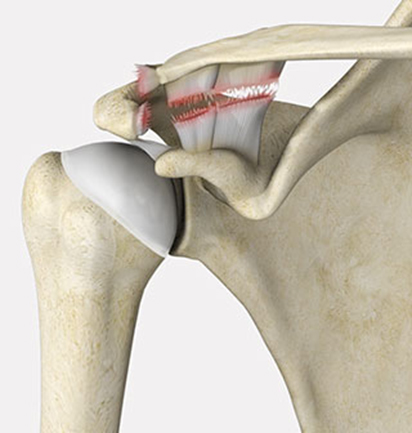
Patients usually walk into clinics describing the same story. A fall onto an outstretched hand, a rugby tackle, a bike crash landing straight onto the point of the shoulder. Within minutes there is pain sitting right at the top of the shoulder, and sometimes a visible bump where there wasn’t one before. This is an AC joint separation, one of the most common shoulder injuries seen in contact sport and cycling accidents, and one that gets misunderstood far more often than it should.
The Joint Itself, and Why It Fails the Way It Does
The acromioclavicular joint is a small, unassuming junction where the outer end of the collarbone meets a bony process on the shoulder blade called the acromion. It does not carry much load on its own, but it acts as a strut that keeps the shoulder blade properly positioned relative to the collarbone during arm movement.
Two sets of ligaments do the real work here. The AC ligaments themselves stabilise the joint horizontally, stopping the collarbone sliding forward or back. The coracoclavicular ligaments, sitting slightly further along, control vertical stability, stopping the collarbone riding up.
A direct fall onto the point of the shoulder, with the arm held close to the body, drives the acromion downward and inward while the collarbone stays relatively fixed in place. This shearing force loads the AC ligaments first. If the impact is severe enough, the coracoclavicular ligaments give way next. The order and extent of ligament failure is exactly what determines the grade of injury, and this is not a minor technical detail. It changes the entire treatment conversation.
Grading the Injury: Why Rockwood Matters More Than the X-ray Alone
Surgeons use the Rockwood classification to describe six grades of AC joint injury, and understanding this changes how a patient should think about their own case.
- Grade I: The AC ligaments are sprained but intact. The joint looks normal on imaging. Pain is present on pressing the joint directly.
- Grade II: The AC ligaments are torn, while the coracoclavicular ligaments are sprained or partially torn. There is mild widening of the joint on imaging, with the collarbone slightly unstable but not badly displaced.
- Grade III: Both ligament groups are torn. The collarbone displaces upward, visible as a step deformity, though the muscle covering (deltotrapezial fascia) usually remains intact.
- Grade IV: The collarbone displaces backward into or through the trapezius muscle, rather than simply upward. This is easy to miss on a standard front facing X-ray and needs a proper axillary view to catch.
- Grade V: A more severe version of grade III, with much greater vertical displacement and the muscle covering torn, giving a far more pronounced visible deformity.
- Grade VI: Rare and severe, where the collarbone displaces downward, sometimes trapped under the coracoid process. This pattern often comes with other significant injuries and needs prompt specialist assessment.
Grades I and II are managed non-surgically in almost every case. Grade III sits in a genuine grey zone, and the decision often depends on the patient’s occupation, sporting demands and personal preference rather than a fixed rule. Grades IV to VI are generally treated surgically, since the anatomy is disrupted badly enough that non-surgical healing rarely restores normal function.
Why an AC Separation Gets Confused With a Distal Clavicle Fracture
This is where two very different injury pathways can look almost identical to a patient in the first hour after injury, and separating them properly is one of the most important parts of the assessment.
Pathway one: ligament failure with an intact bone. Here, the force travels entirely through the AC and coracoclavicular ligaments. The bone itself stays structurally sound. The deformity, when present, comes from the collarbone shifting position relative to the shoulder blade, not from a break in the bone.
Pathway two: fracture through the distal clavicle. In this pattern, the ligaments may actually stay attached to a fragment of bone, and instead the collarbone fractures near its outer end, sometimes right where the coracoclavicular ligaments insert. The visible bump and pain pattern can look remarkably similar to a straightforward AC separation on first glance.
The consequence of confusing the two is real. Treating a displaced distal clavicle fracture as a simple ligament sprain, or vice versa, changes both the healing timeline and the surgical technique required if an operation is needed. A distal clavicle fracture with ligament attachment often needs specific fixation hardware, while a pure ligament injury needing surgery is reconstructed using graft or synthetic material instead. Dedicated X-ray views, including Zanca and axillary views, can help clarify the injury, while CT may be considered if the fracture pattern remains uncertain. Distinguishing between the two ensures that treatment is planned for the correct injury.
Getting the Treatment Decision Right
Non-surgical management for grade I and II injuries typically involves a short period in a sling for comfort, ice in the early days, and a structured physiotherapy programme focused on restoring range of motion before rebuilding strength around the shoulder blade and rotator cuff. Most patients return to full activity within six to twelve weeks.
Surgical management, when needed, generally falls into two camps. When surgery is needed, its timing depends on the injury pattern, symptoms and response to initial treatment. Delayed reconstruction may be more technically complex, but it can still provide good outcomes when pain or instability persists.
For some overhead athletes and manual workers with a type III injury, surgery may be considered if pain, weakness or instability persists despite rehabilitation.
FAQs
Can an AC joint separation heal without surgery?
Mild grade I and II injuries generally heal with rest and physiotherapy alone, without the need for surgery. Type III injuries often improve without surgery, while types IV to VI usually require specialist assessment and are commonly treated surgically.
Will the bump on my shoulder go away after treatment?
In grade I and II injuries, swelling settles, and the shoulder usually looks normal again. In grade III and above, some visible prominence of the collarbone often remains even after successful treatment, whether managed surgically or not, though function can still be excellent.
How soon can I get back to sport after an AC joint injury?
Grade I injuries often allow a return within two to four weeks. Grade II typically needs four to six weeks. Surgically treated higher-grade injuries usually need four to six months before contact sport, since the reconstructed ligaments need time to mature and bear load safely.
For enquiries and online appointments, send a message to
www.DrAyyappanVNair.com/contact
For informative videos related to Shoulder problems and their treatment options, Sports Injuries and other orthopedic conditions, visit our YouTube channel Bangalore Shoulder Institute – https://www.youtube.com/@BangaloreShoulderInstitute