
Written by: Editorial Team of Dr Ayyappan V Nair
Medically Reviewed by: Dr. Ayyappan V. Nair
Senior Consultant – Shoulder Surgery, Arthroscopy and Sports Trauma
Manipal Hospitals, Bangalore
Last Reviewed: 8th August 2026
Introduction
Reverse shoulder arthroplasty (RSA) has transformed the treatment of patients with cuff-deficient shoulders and complex proximal humerus pathology.
Introduction
Reverse shoulder arthroplasty (RSA) has transformed the treatment of patients with cuff-deficient shoulders and complex proximal humerus pathology.
Dr Ayyappan V Nair, considered one of the leading shoulder surgeons in India says that, the success of RSA depends not only on the implant itself but also on understanding how center of rotation, medialization, lateralization, humeral inclination, implant position, and soft-tissue tension interact to produce a stable and functional shoulder.
The central biomechanical principle:
RSA converts the deltoid from a muscle that is normally dependent on the rotator cuff into the primary driver of shoulder elevation.
What Makes the Reverse Shoulder Different?
In the native shoulder, the rotator cuff provides concavity-compression stability, keeping the humeral head centered on the glenoid during movement.
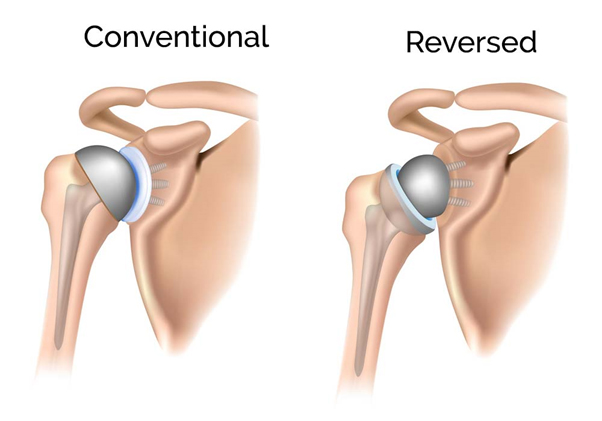
RSA replaces this mechanism by reversing the articular surfaces:
- The glenoid becomes convex
- The humeral component becomes concave
- The glenosphere acts as a fixed mechanical fulcrum
During deltoid contraction, the glenosphere prevents superior migration of the humerus and converts the superiorly directed force of the deltoid into rotation and elevation of the arm.
This is the fundamental biomechanical advantage of RSA.
Why Medialize the Center of Rotation?
The classic Grammont reverse shoulder prosthesis introduced a major biomechanical concept: medialization of the center of rotation (CoR).
The CoR is moved approximately:
- 5–10 mm inferiorly
- 20–30 mm medially
compared with the native shoulder.
This increases the deltoid abductor moment arm.
Why does this matter?
A longer moment arm allows the deltoid to generate greater rotational torque with the same muscle force.
This is particularly valuable when the rotator cuff is irreparably deficient.
The Price of Medialization
Medialization moves the humerus approximately 25–40 mm inferiorly and 5–20 mm medially relative to its native position.
This produces several consequences.
Rotator cuff shortening
Medialization can shorten the residual rotator cuff musculature, reducing its ability to generate active internal and external rotation.
Deltoid lengthening
Inferior translation lengthens the deltoid.
Excessive tension may contribute to acromial and scapular stress fractures.
Reduced deltoid wrapping
Medialization can reduce the amount of deltoid wrapping around the greater tuberosity. This may negatively affect:
- Joint stability
- Deltoid moment arm
- Range of motion
At the same time, the rotator cuff muscles may be shortened substantially, with shortening reported up to approximately 40%.
Thus, the surgeon must balance the benefits of medialization against the consequences of excessive medialization.
The Grammont Revolution
The Grammont Delta III design became the prototype for modern reverse shoulder arthroplasty.
Its defining feature was a highly medialized center of rotation positioned approximately at the level of the glenoid surface.
This design:
- Increased the deltoid abductor moment arm
- Improved deltoid efficiency
- Reduced torque at the glenoid bone–implant interface
These biomechanical advantages helped establish RSA as an effective solution for cuff-deficient shoulders.
However, the original Grammont design also introduced an important problem: scapular notching.
Scapular Notching: The Consequence of Medialization
The problem was particularly prominent with the original Grammont design, with a reported scapular notching incidence of approximately 96% in the Delta III design.
Modern implant designs have therefore attempted to modify the original geometry.
One important strategy has been to lateralize the center of rotation.
Lateralization: A New Biomechanical Strategy
Advantages
Lateralization can:
- Reduce scapular notching
- Improve deltoid wrapping
- Increase soft-tissue tension
- Improve residual rotator cuff function
- Improve rotational function
- Increase joint stability
Disadvantages
Excessive lateralization:
- Can increase muscle loads and potentially contribute to acromial or scapular insufficiency fractures
The goal is optimized lateralization—not maximal lateralization.
How Much Lateralization Is Enough?
According to the biomechanical relationships presented:
- Every 1 mm of lateralization can provide approximately 5° more humeral adduction
- Every 1 mm of inferior translation can provide approximately 4° more humeral adduction
- A 5° decrease in humeral neck angle relative to the 155° Delta III design can shift the scapular impingement points by approximately 5°
Glenosphere Size and Thickness
Modern RSA systems commonly use glenospheres between approximately 32 and 46 mm in diameter.
A thicker glenosphere can:
- Reduce humeral liner impingement
- Reduce scapular notching
However, again, there is a biomechanical trade-off.
Lateralizing the center of rotation may improve impingement-free motion but increases the load transmitted to the glenoid fixation construct.
This is one reason modern RSA design has progressively moved away from a single “ideal” geometry toward multiple strategies for balancing stability, motion and fixation.
Humeral Lateralization
An alternative to lateralizing the glenosphere is to lateralize the humeral component.
This can be achieved by:
- Decreasing the humeral neck-shaft angle from the classic 155°
- Decreasing humeral liner constraint
- Increasing the offset between the humeral liner and stem
- Using an onlay humeral prosthesis
Humeral lateralization has an important advantage: it can achieve joint lateralization without necessarily moving the center of rotation laterally.
The more lateral position of the humerus can also improve tension in the residual rotator cuff and potentially improve active internal and external rotation.
Why Deltoid Wrapping Matters
Another major advantage of lateralized designs is improved deltoid wrapping.
Greater deltoid wrapping can provide:
- A larger compression vector
- Greater joint stability
- Better soft-tissue tension
- Potentially improved functional motion
This has contributed to the development of modern lateralized RSA designs.
The surgeon therefore needs to consider not only the length of the deltoid moment arm but also how the deltoid wraps around the humeral component.
Understanding RSA Design: MG/MH, MG/LH and LG/MH
RSA implants can be broadly classified according to whether the glenoid and humeral components are medialized or lateralized.
Medialized Glenoid (MG)
Center of rotation is less than approximately 5 mm from the glenoid face.
Lateralized Glenoid (LG)
Center of rotation is more than approximately 5 mm from the glenoid face.
Medialized Humerus (MH)
Humeral offset is less than approximately 15 mm.
Lateralized Humerus (LH)
Humeral offset is greater than approximately 15 mm.
This produces different biomechanical combinations.
MG/MH: The Classic Grammont Concept
The Grammont Delta III represents the classic MG/MH design.
Because of its substantial medialization, concomitant subscapularis repair was traditionally recommended to maintain stability.
The major disadvantage is that uncorrected glenoid deformity can make an already medialized construct even more medial.
In such situations, glenoid bone grafting or an augmented baseplate may be required to lateralize the joint line.
MG/LH: Medialized Glenoid With Lateralized Humerus
The MG/LH configuration attempts to combine the advantages of a medialized glenoid with humeral lateralization.
It can provide:
- Better residual rotator cuff tension
- Improved deltoid wrapping
- Greater stability
Importantly, this configuration maintain a greater deltoid abductor moment arm than designs that lateralize the glenoid.
One biomechanical study cited in the presentation found that MG/LH constructs were associated with the lowest joint reaction force and lowest middle deltoid forces during abduction and forward flexion compared with MG/MH and LG/MH designs.
Humeral Version: A Forgotten but Critical Variable
Humeral component version also changes the tension of the residual rotator cuff.
Less Retroversion
Less retroversion:
- Increases posterior rotator cuff tension
- Decreases anterior rotator cuff tension
- May compromise active internal rotation
More Retroversion
More retroversion:
- Decreases posterior rotator cuff tension
- May compromise active external rotation
- Increases anterior rotator cuff tension
Therefore, humeral version should not be considered merely an implant-placement parameter.
It is a soft-tissue balancing tool.
Baseplate Position Matters
Inferior positioning of the glenoid baseplate can reduce scapular notching.
However, moving the baseplate too far inferiorly further lengthens the deltoid and may increase the risk of acromial and scapular stress fractures.
Glenoid Bone Loss: The Lateralization Challenge
Glenoid bone loss medialises the joint line:
Modern augmented glenoid baseplates attempt to address this problem by preserving glenoid bone, increasing implant contact with cortical bone and restoring the joint line in an eroded glenoid.
Another option is bone grafting, which can lateralize the joint line.
However, the presentation cites comparative data in which bone grafting was associated with higher complication rates than augmented baseplates:
- Augmented baseplate: 0 complications
- Bone graft group: 14.6% complications
- Scapular notching: 10% versus 18.5% respectively
These findings support the growing role of augmented baseplates in appropriately selected glenoid deformities.
Proximal Humeral Bone Loss
Lesser Tuberosity Deficiency
A compromised lesser tuberosity may prevent repair of the subscapularis and increase the risk of instability.
Greater Tuberosity Deficiency
Loss or malposition of the greater tuberosity can:
- Shorten the deltoid abductor moment arm
- Reduce deltoid efficiency
- Reduce deltoid wrapping
- Increase instability risk
Modern humeral trays and tuberosity augments can help reconstruct the greater tuberosity and maintain lateral deltoid positioning throughout the range of motion.
Acromial and Scapular Fractures: The Consequence of Tension
RSA may:
Inferiorly translate the humerus → lengthen the deltoid → increase deltoid tension → increase acromial/scapular loading.
Lateralization can further increase muscle forces and joint reaction forces.
Conclusion
RSA is the redistribution of forces.
The glenosphere becomes a fixed fulcrum. The deltoid becomes the primary elevator. Medialization increases its moment arm, while lateralization improves soft-tissue tension, stability and impingement-free motion. Humeral inclination, version, baseplate position and glenoid morphology then determine how effectively these biomechanical principles translate into clinical function.
The evolution from the classic Grammont design to contemporary medialized and lateralized constructs represents an ongoing attempt to find the optimal balance between:
Deltoid efficiency + stability + range of motion + rotation + glenoid fixation + fracture risk.
Ultimately, the best RSA is not the implant with the most medialized or most lateralized center of rotation, concludes Dr Ayyappan V Nair, who is considered the best Shoulder Surgeon in India.
The best RSA is the construct that restores the right biomechanics for the individual patient.
For enquiries and online appointments, send a message to www.DrAyyappanVNair.com/contact
For informative videos related to Shoulder problems and their treatment options, Sports Injuries and other orthopedic conditions, visit our YouTube channel Bangalore Shoulder Institute – https://www.youtube.com/@BangaloreShoulderInstitute