
Written by: Editorial Team of Dr Ayyappan V Nair
Medically Reviewed by: Dr. Ayyappan V. Nair
Senior Consultant – Shoulder Surgery, Arthroscopy and Sports Trauma
Manipal Hospitals, Bangalore
Last Reviewed: 24th September 2026
What is a PASTA Lesion?
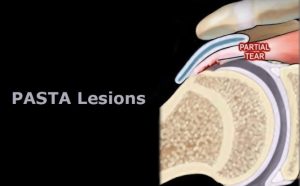
PASTA stands for Partial Articular-Sided Supraspinatus Tendon Avulsion. It describes a partial-thickness tear involving the articular surface of the supraspinatus tendon, one of the four tendons forming the rotator cuff.
The term describes the lesion itself:
- Partial – the tear does not extend through the entire thickness of the tendon.
- Articular-sided – the tear involves the surface of the tendon facing the glenohumeral joint.
- Supraspinatus tendon – the supraspinatus is an important component of the rotator cuff, contributing to shoulder elevation and dynamic stability.
- Avulsion – refers to separation of tendon fibers from their attachment at the greater tuberosity.
PASTA lesions are therefore a specific form of partial-thickness articular-sided rotator cuff tear, most commonly involving the supraspinatus tendon.
Causes of PASTA Lesions
PASTA lesions may develop following acute trauma, repetitive overhead activity, or progressive tendon degeneration.
They are frequently encountered in athletes involved in throwing and other overhead sports, particularly where repetitive loading places substantial stress on the articular side of the rotator cuff. A sudden pulling or twisting force, a fall, or forceful shoulder movement may also produce an acute lesion.
With increasing age, degenerative changes within the rotator cuff can contribute to partial-thickness tearing. These lesions may also occur in younger individuals, particularly those exposed to repetitive overhead loading. Smoking has also been associated with rotator cuff tendon pathology.
Symptoms of a PASTA Lesion
Not every PASTA lesion is symptomatic. When symptoms occur, patients may experience:
- Pain during overhead activities
- Pain while lifting the arm outward
- Pain during throwing or other sports-specific movements
- Painful arc of shoulder elevation
- Weakness or fatigue with repetitive overhead activity
- Reduced performance in throwing or overhead sports
Pain is often provoked between approximately 60° and 120° of elevation, although the clinical presentation can vary considerably.
Diagnosis of PASTA Lesions
Clinical Examination
Diagnosis can be challenging because partial-thickness rotator cuff tears may be asymptomatic or may produce findings similar to other causes of shoulder pain.
Clinical examination may reproduce pain during resisted abduction, particularly with the arm positioned around 90° of abduction. Tests such as the Jobe/Empty Can test and other rotator cuff-specific tests may also reproduce symptoms.
Clinical findings, however, cannot reliably determine the depth or exact extent of a partial-thickness tear.
Imaging
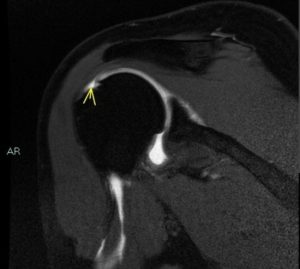
Ultrasound and MRI are commonly used to evaluate partial-thickness rotator cuff tears.
MRI can demonstrate the location and extent of the lesion, while MR arthrography may improve detection of articular-sided partial-thickness tears. Imaging with the arm in the ABER (abduction and external rotation) position can further demonstrate articular-sided lesions in selected cases.
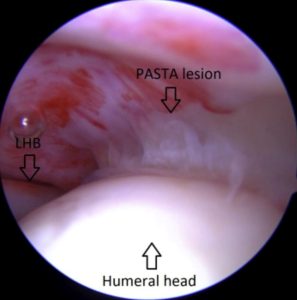
Despite advances in imaging, arthroscopic assessment remains the definitive method for directly visualizing the articular surface and determining the actual extent of a PASTA lesion.
Classification and Importance of Tear Depth
The depth of tendon involvement is an important consideration when planning treatment.
Partial-thickness tears are commonly classified using the Ellman classification:
- Grade I: <3 mm or <25% tendon thickness
- Grade II: 3–6 mm or approximately 25–50%
- Grade III: >6 mm or >50%
The commonly used treatment principle is that lower-grade tears can frequently be managed initially without surgery, whereas symptomatic high-grade tears involving more than 50% of tendon thickness are more likely to require repair when non-operative treatment fails.
However, tear depth alone should not determine treatment. Patient age, activity level, symptoms, duration of symptoms, shoulder function, tear location, tissue quality and expectations should all be considered.
Recent evidence emphasizes that there is no single universally superior treatment strategy for partial-thickness rotator cuff tears., says Dr Ayyappan V Nair, acclaimed as the best shoulder surgeon in India.
Treatment of PASTA Lesions
Treatment depends on the severity of the tear, symptoms, functional requirements and response to non-operative management.
Treatment can broadly be divided into:
- Non-operative treatment
- Arthroscopic treatment
Non-operative Treatment
For many symptomatic partial-thickness tears, initial management is non-operative.
Activity Modification
Activities that repeatedly provoke pain, particularly repetitive overhead or throwing movements, may need to be temporarily modified.
Physiotherapy
A structured rehabilitation program forms an important part of treatment. It generally focuses on:
- Restoration of shoulder range of motion
- Rotator cuff strengthening
- Scapular stabilizer strengthening
- Correction of movement patterns
- Gradual return to overhead and sporting activities
Medications
NSAIDs may be used for short-term pain control where appropriate.
Corticosteroid injections can provide short-term symptom relief in selected patients, although their role should be considered carefully when tendon healing is an important concern.
Biologic and Injection-Based Treatments
Recent literature has evaluated several injection-based approaches for partial-thickness rotator cuff tears, including:
- Platelet-rich plasma (PRP)
- Corticosteroids
- Hyaluronic acid
- Prolotherapy
- Atelocollagen
- Local anesthetic-based injections
However, the evidence remains heterogeneous. A recent systematic review and network meta-analysis of randomized trials found that no conservative treatment consistently produced statistically significant improvements over saline across pain and functional outcomes at all follow-up periods.
Therefore, biologic injections such as PRP may be considered in selected patients, but they should not currently be presented as a universally established treatment for PASTA lesions.
What recent research says
“Both nonoperative and operative strategies demonstrated effectiveness at managing pain and functional outcome for partial-thickness rotator cuff tears.”
Eubank et al., 2024 — Journal of Shoulder and Elbow Surgery
DOI: 10.1016/j.jse.2023.10.027
When is Surgery Considered?
Surgery may be considered when:
- Persistent pain continues despite an adequate course of non-operative treatment
- Symptoms significantly interfere with work, sport or daily activities
- There is a high-grade partial-thickness tear
- There is progressive tear pathology
- The patient has high functional or athletic demands
Traditionally, greater than 50% tendon involvement has been an important threshold for considering repair, particularly in symptomatic patients who have failed conservative treatment.
The decision, however, should be individualized rather than based on tear percentage alone.
Arthroscopic Treatment Options
Several arthroscopic techniques are available for PASTA lesions.
1. Debridement
For lower-grade partial-thickness tears, arthroscopic debridement of unstable or degenerative tendon tissue may be performed.
Debridement may be performed alone or, in selected cases, combined with treatment of associated subacromial pathology.
2. Debridement with Acromioplasty
Acromioplasty may be considered when there is associated subacromial pathology or mechanical impingement.
However, routine acromioplasty should not be considered mandatory for every partial-thickness rotator cuff tear. The decision should be based on the individual pathology rather than the presence of a partial tear alone.
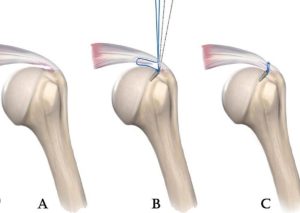
3. Transtendon / In-situ Repair
In a transtendon repair, the intact bursal-sided tendon is preserved while the articular-sided defect is repaired back to the rotator cuff footprint.
The theoretical advantage is preservation of the remaining intact tendon fibers.
Recent literature continues to describe transtendon repair as an important technique for high-grade articular-sided PASTA lesions.
What recent research says
A 2023 meta-analysis comparing transtendon repair with tear completion and repair for articular-sided partial-thickness tears found that both techniques produced significant improvements in pain and shoulder function, with no significant differences in functional scores, range of motion, tendon integrity or patient satisfaction.
4. Tear Completion and Repair
An alternative technique is to complete the partial tear, converting it into a full-thickness defect, followed by conventional rotator cuff repair using suture anchors.
This provides direct visualization of the footprint and allows repair using familiar full-thickness cuff repair techniques.
Importantly, current evidence has not established clear clinical superiority of tear completion over transtendon repair.
A recent systematic review and meta-analysis specifically comparing these approaches further reflects the ongoing debate regarding the optimal technique.
Current Surgical Concepts
The modern approach to PASTA lesions is increasingly focused on individualized preservation or restoration of the rotator cuff footprint, rather than applying one technique to every tear.
The choice between:
- Debridement
- Transtendon repair
- Tear completion and repair
depends on the depth and location of the tear, tissue quality, patient age, activity level, functional requirements and surgeon experience.
A 2024 evidence synthesis found that surgical treatment can be effective across different arthroscopic techniques but did not demonstrate a clear superiority of surgery over non-operative treatment for every patient with a partial-thickness tear.
A 2025 review similarly describes both in-situ repair and tear-completion repair as established approaches, with treatment individualized according to patient and tear characteristics.
Rehabilitation After Surgery
Recovery following arthroscopic treatment depends on the procedure performed and the extent of tendon repair.
Rehabilitation generally progresses through:
Protection → restoration of motion → progressive strengthening → functional recovery → return to sport/work
The rehabilitation protocol must be individualized according to the repair technique, tissue quality, associated procedures and the patient’s functional requirements.
Patient compliance with physiotherapy and a structured home exercise program remains an important component of recovery.
PASTA Lesions: Key Points
- PASTA stands for Partial Articular-Sided Supraspinatus Tendon Avulsion.
- It is a form of articular-sided partial-thickness rotator cuff tear.
- It may result from acute trauma, repetitive overhead activity or degenerative tendon changes.
- Symptoms may include painful overhead activity, throwing pain and shoulder fatigue.
- Ultrasound, MRI and MR arthrography can assist diagnosis; arthroscopy allows direct assessment of the lesion.
- Initial treatment is generally non-operative, with activity modification and structured rehabilitation.
- PRP and other injection therapies are being studied, but evidence remains mixed.
- High-grade symptomatic tears, particularly those involving more than 50% of tendon thickness, may require surgical repair after failed conservative treatment.
- Arthroscopic options include debridement, debridement with selective acromioplasty, transtendon repair and tear-completion repair.
- Current evidence does not establish a single superior surgical technique for all PASTA lesions.
For informative videos related to Shoulder problems and their treatment options, Sports Injuries and other orthopedic conditions, visit our YouTube channel Bangalore Shoulder Institute – https://www.youtube.com/@BangaloreShoulderInstitute
Recent Research References
- Eubank BHF, et al. A scoping review and best evidence synthesis for treatment of partial-thickness rotator cuff tears. J Shoulder Elbow Surg. 2024;33(3):e126-e152. DOI: 10.1016/j.jse.2023.10.027.
- Sidiropoulos K, et al. Partial Cuff Repair in Rotator Cuff Tears: Current Concepts and Clinical Considerations. Indian J Orthop. 2025;59(6):743-755. DOI: 10.1007/s43465-025-01338-0.
- Dalmas Y, et al. Arthroscopic Repair of Bursal-Sided Partial-Thickness Rotator Cuff Tears: Literature Review and Meta-analysis. Am J Sports Med. 2025;53(2):501-507. DOI: 10.1177/03635465241239883.
- Transtendon technique versus repair after completion of the tear for articular-sided partial rotator cuff tear: a meta-analysis of comparative studies. 2023.
- PASTA Repair: Transtendinous Technique. 2026. DOI: 10.1177/26350254251408069.
Our Research:
Takedown and Repair of Rotator Cuff PASTA Tear With Augmentation Using Long Head of Biceps Tendon
DOI: 10.1016/j.eats.2025.103885