
Written by: Editorial Team of Dr Ayyappan V Nair
Medically Reviewed by: Dr. Ayyappan V. Nair
Senior Consultant – Shoulder Surgery, Arthroscopy and Sports Trauma
Manipal Hospitals, Bangalore
Last Reviewed: 8th August 2026
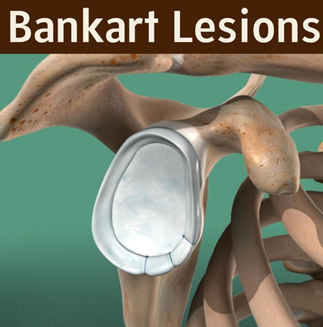
A Bankart lesion is a tear of the anteroinferior labrum, typically after an anterior shoulder dislocation. It was first described by Arthur Sydney Blundell Bankart. If bone is also involved at the glenoid rim, it’s called a bony Bankart lesion. A related injury is the Hill-Sachs lesion on the humeral head. Without proper management, these injuries can lead to recurrent instability.
Common causes
Contact sports, falls, traffic accidents, and repetitive overhead activity, especially in young active individuals.
Symptoms
Patients often report shoulder pain, a feeling of looseness or instability, recurrent dislocations, clicking or popping sensations, weakness, and reduced range of motion.
Diagnosis
Diagnosis involves a physical exam and imaging. X-rays can identify dislocation or fractures, while MRI or MR arthrography is useful for labral tears. CT is considered when bone loss is suspected.
Treatment
Treatment depends on age, activity level, and instability risk.
Conservative management is appropriate for selected first-time dislocations, low-demand patients, or those without significant bone loss. Treatment emphasises brief immobilisation followed by structured rehabilitation focusing on rotator cuff strengthening, scapular stabilisation, proprioception, and neuromuscular control
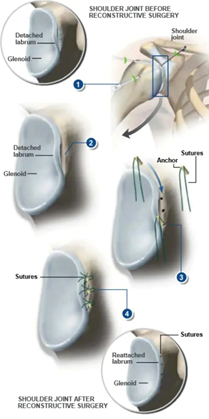
Surgery is common for young athletes or recurrent instability. Dr Ayyappan V Nair, a leading surgeon in Shoulder Problems says Arthroscopic Bankart repair is commonly performed, with other procedures considered if there is significant bone loss.
- Open Bankarts repair-strong, more invasive
- Arthroscopic knotted repair-strong fixation, technically demanding
- Arthroscopic knotless repair -faster,easier,but limited tension control
- All suture anchor repair-preserve bone,good for young patient
- Transosseous repair-no implants, not used nowadays
- Reapir with capsular plication-addresses laxity by tightening capsule
- Remplissage with repair- for hill sachs,low recurrence with slight loss of external rotation
- Latarjet procedure- Better for patients with significant glenoid bone loss
Emerging advances include biological augmentation with platelet-rich plasma or bioinductive scaffolds, patient-specific preoperative planning, and improved arthroscopic instrumentation, all aimed at enhancing healing, restoring biomechanics, and reducing recurrence rates.
Rehabilitation is essential, with gradual return to activity over four to six months. Risk reduction strategies include proper technique, protective equipment where relevant, shoulder strengthening, and avoiding early return to sport. See an orthopaedic surgeon if your shoulder repeatedly slips out, feels unstable, or pain persists after injury.
Early diagnosis supports better stability and safer return to daily life.
References include Bankart ASB 1923, Burkhart and De Beer 2000, Itoi et al. 2013, Provencher et al. 2012, and guidance from the American Academy of Orthopaedic Surgeons.
NEW STUDY
Virág-Tulassay EE, Kancsev A, Lengyel AS, et al. Bankart surgery is the most effective treatment for first-time anterior shoulder dislocation without significant bone loss – Systematic review and network meta-analysis. Journal of Orthopaedic Translation. 2026;56:101007.
Arthroscopic Bankart repair showed the best outcomes, Lower risk of recurrent dislocation, Better return to sports, Conservative treatment has a role—but not for everyone, Treatment should always be individualized based on the patient’s age, activity level, imaging findings, and the presence of associated bone defects
The results indicated that arthroscopic Bankart surgery was 0.18 [OR, 95 % CI 0.05–0.58] times less likely to result in redislocation than external rotation fixation and 0.45 [OR, 95 % CI 0.26–0.76] times less likely than internal rotation fixation. Further more, ER imm was 0.08 [OR, 95 % CI 0.03–0.24] times less likely to be associated with redislocation than internal rotation immobilization
Arthroscopic Bankart surgery was 4.66 [OR, 95 % CI 1.12–19.49] times more likely to lead to a shorter rehabilitation period than external rotation fixation and 9.79 [OR, 95 % CI 3.20–29.97] times more likely compared to internal rotation fixation.
OUR FINDINGS:
Dr Ayyappan V Nair et al. A short term analysis of external rotation deficit following a combined arthroscopic bankart with remplissage and rotator interval closure for anteroinferior instability with subcritical bone loss
48 patients study during 2019-2023 with 6months follow up . The average age of the patients was 31.7 years (range, 16-52 years), with 93.8% male patients and 6.2% female patients. The range of motion at follow-up was comparable with the normal side, with loss of terminal external rotation in 2 patients (4%). One patient had only one episode of subluxation and there was one case of infepatient.Excellent functional outcomes, least rate of recurrence and without significant loss of external rotation.
Dr Ayyappan V Nair et al.Arthroscopic Fixation of Acute Large Bony Bankart with Suture-assisted Reduction and Screw Fixation – Surgical Technique
Arthroscopic suture-assisted reduction and screw fixation provides a minimally invasive fail-safe management to treat acute bony Bankart, by preventing malrotation and facilitating early union
For enquiries and online appointments, send a message to
www.DrAyyappanVNair.com/contact
For informative videos related to Shoulder problems and their treatment options, Sports Injuries and other orthopedic conditions, visit our YouTube channel Bangalore Shoulder Institute – https://www.youtube.com/@BangaloreShoulderInstitute