
Written by: Editorial Team, Bangalore Shoulder Institute
Medically Reviewed by: Dr. Ayyappan V. Nair (https://drayyappanvnair.com)
Senior Consultant – Shoulder Surgery, Arthroscopy and Sports Trauma
Manipal Hospitals, Bangalore
Last Reviewed: 20th September 2026
The subscapularis lies directly anterior to the glenohumeral capsule and must be released to gain access to the joint. Three principal techniques are described:
- Subscapularis tenotomy
- Subscapularis peel
- Lesser tuberosity osteotomy (LTO)
The choice of technique has implications for exposure, healing biology, postoperative external rotation, and the risk of subscapularis failure.
Subscapularis Tenotomy
For a tenotomy, the arm is positioned in adduction and external rotation. This tensions the subscapularis and moves the tenotomy site farther away from the axillary nerve.
Two sutures can be placed in the medial aspect of the tendon to maintain tension during the tenotomy and facilitate subsequent repair later. The tendon is generally divided approximately 1 cm medial to its insertion. When releasing the inferior portion, the anterior humeral circumflex artery and its accompanying veins should be identified and cauterized to minimize bleeding.
Advantages
The principal advantage of tenotomy is the potential for reliable tendon-to-tendon healing.
Disadvantages
The tendon cannot be readily medialized, and excessive shortening during repair may limit postoperative external rotation.
An important technical consideration is the location of the tenotomy. A cut that is too lateral may leave an inadequate tendon stump for repair, whereas a cut that is too medial can extend into the musculotendinous junction and compromise suture fixation.
Subscapularis Peel
With the peel technique, the subscapularis is elevated in its entirety from its lesser tuberosity insertion.
The major advantage is the ability to medialize the tendon insertion, which can be useful when additional tendon excursion is required. The principal disadvantage is that healing occurs through a tendon-to-bone interface rather than tendon-to-tendon healing.
Following a peel, the tendon can be repaired through bone tunnels using braided non-absorbable sutures. If the glenohumeral offset has been substantially medialized, the tendon repair can also be positioned more medially.
Lesser Tuberosity Osteotomy: Bone-to-Bone Healing
Lesser tuberosity osteotomy preserves the subscapularis tendon while mobilizing its bony insertion. The long head of the biceps is initially addressed, commonly with tenodesis to the upper margin of the pectoralis major tendon, after which the lesser tuberosity is exposed.
The osteotomy is performed from the medial aspect of the bicipital groove toward the bone-cartilage interface at the anatomic neck.
Why Choose LTO?
The principal theoretical advantages are:
- Bone-to-bone healing
- Preservation of the subscapularis tendon itself
- Ability to medialize the tendon if required
The disadvantages include greater technical complexity, increased operative time, and the potential for iatrogenic fracture or nonunion.
Biomechanical Considerations
Cadaveric comparisons have evaluated tenotomy, peel, and LTO techniques.
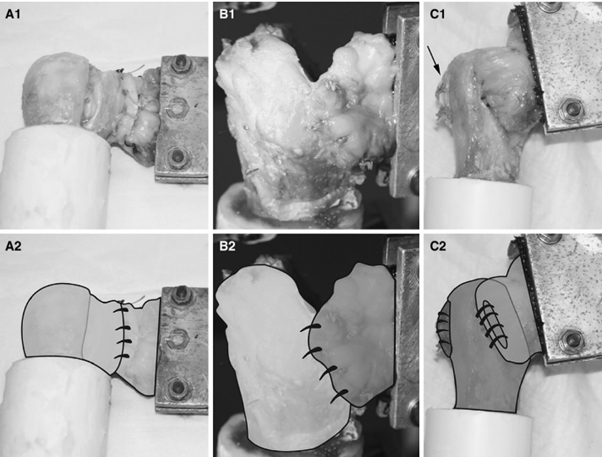
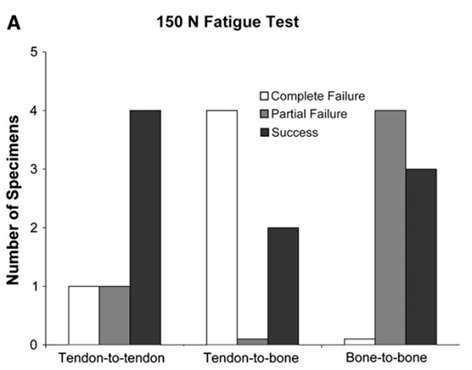
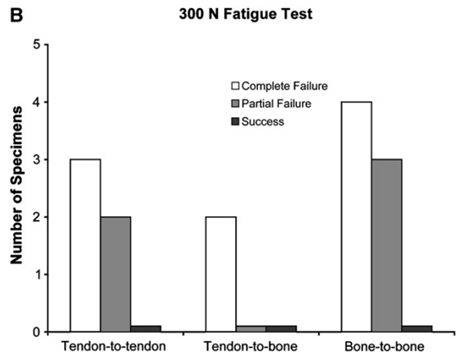
In one model [1], specimens were cyclically loaded at 150 N for 500 cycles followed by 300 N for 1,500 cycles. Complete separation of the repair was considered failure, while elongation greater than 5 mm without complete separation was considered partial failure.
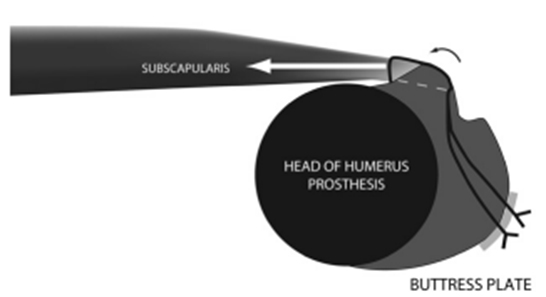
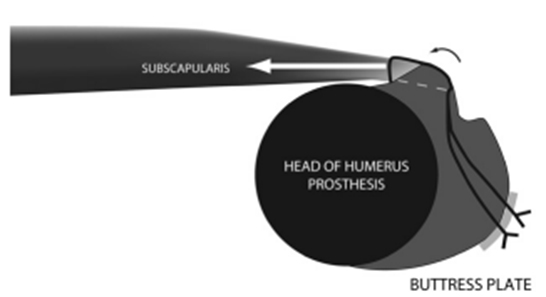
The presentation also highlights a technical consideration with LTO repair: a simple mattress-suture configuration can allow the lesser tuberosity fragment to open laterally.
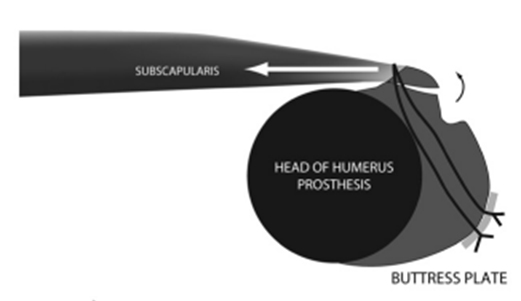
A “back-pack” suture configuration creates a tension-band effect that helps maintain the fragment against the pull of the subscapularis.
Clinical comparisons with retrospective studies [2] showed improved clinical outcomes and lower rates of subscapularis tears in osteotomy group. Penn shoulder score 81+-20 vs 92+-11, postop ultrasound showing 8 vs 18 intact subscapularis, external rotation 57+-15 vs 50+-11 in tenotomy and LTO group respectively
Another clinical study comparing LTO and subscapularis peel group [3] showed comparable healing rate in the 2 groups (95% vs 100%). But higher fatty infiltration was noted in peel group with lesser strength, WOOS score (83.87 vs 86.8) and ASES score (77.07 vs 81.46)
Subscapularis Repair: The Critical Final Step
Following implantation, the wound is thoroughly irrigated and the subscapularis is repaired.
For a tenotomy, multiple figure-of-eight braided sutures can be used to restore the tendon anatomically. Avoiding excessive shortening is essential because overtightening can compromise external rotation.
Multiple simple absorbable sutures placed approximately every 3–4 mm distribute the load across multiple fixation points. The anterior edge of the supraspinatus can also be approximated to the superior edge of the subscapularis [4]. The arm is maintained in external rotation during repair to reduce overtensioning of the rotator interval.
In subscapularis peel off, tendon is repaired using bone tunnelsextending from anatomic neck of humerus to LT. braided, non-absorbable sutures are passed through drill holes and subscapularis tendon and are tied down in a secure fashion. If glenohumeral offset was substantially medialized during the procedure, repair of tendon may be moved more medially.
(One of the technique has been described in video 1) [5]
For LTO, transosseous sutures can be placed around the lesser tuberosity and through the subscapularis. Depending on bone quality and surgeon preference, plate augmentation may be considered.
Modern suture constructs may incorporate multiple transosseous tunnels and implant-associated sutures to achieve compression across the osteotomy. The goal is stable apposition of the lesser tuberosity while avoiding excessive tension on the repair. [6]
The rotator interval may be reinforced using figure-of-eight non-absorbable sutures. Finally, the deltopectoral interval is loosely closed, followed by layered closure of the subcutaneous tissue and skin.
Take-Home Message
Tenotomy offers tendon-to-tendon repair, peel permits tendon medialization but relies on tendon-to-bone healing, and lesser tuberosity osteotomy provides a bone-to-bone healing interface while preserving the tendon. Each technique has specific advantages and limitations says Dr Ayyappan V Nair, acclaimed to be the best shoulder surgeon in India.
A secure—but not overly tight—subscapularis repair are central to achieving a stable and functional shoulder arthroplasty through the deltopectoral approach
For informative videos related to Shoulder problems and their treatment options, Sports Injuries and other orthopedic conditions, visit our YouTube channel Bangalore Shoulder Institute – https://www.youtube.com/@BangaloreShoulderInstitute
REFERENCES
- Van den Berghe GR, Nguyen B, Patil S, D’Lima DD, Mahar A, Pedowitz R, Hoenecke HR. A biomechanical evaluation of three surgical techniques for subscapularis repair. J Shoulder Elbow Surg. 2008 Jan-Feb;17(1):156-61. doi: 10.1016/j.jse.2007.04.016. Epub 2007 Nov 1. PMID: 17931907.
- Scalise JJ, Ciccone J, Iannotti JP. Clinical, radiographic, and ultrasonographic comparison of subscapularis tenotomy and lesser tuberosity osteotomy for total shoulder arthroplasty. J Bone Joint Surg Am. 2010 Jul 7;92(7):1627-34. doi: 10.2106/JBJS.G.01461. PMID: 20595569.
- Lapner PL, Sabri E, Rakhra K, Bell K, Athwal GS. Healing rates and subscapularis fatty infiltration after lesser tuberosity osteotomy versus subscapularis peel for exposure during shoulder arthroplasty. J Shoulder Elbow Surg. 2013 Mar;22(3):396-402. doi: 10.1016/j.jse.2012.05.031. Epub 2012 Sep 1. PMID: 22944077.
- Daly CA, Hutton WC, Jarrett CD. Biomechanical effects of rotator interval closure in shoulder arthroplasty. J Shoulder Elbow Surg. 2016 Jul;25(7):1094-9. doi: 10.1016/j.jse.2015.12.003. Epub 2016 Feb 17. PMID: 26897316.
- Meyers A, Barnes C, Dugarte A, Nelson R. A novel technique for subscapularis repair in total shoulder arthroplasty. JSES Rev Rep Tech. 2023 Feb 3;3(2):215-218. doi: 10.1016/j.xrrt.2023.01.004. PMID: 37588439; PMCID: PMC10426494.
- Cohn MR, Baker W, Schiffman CJ, Vadhera AS, Bustamante S, Austin LS. Tensionable lesser tuberosity osteotomy repair for anatomic total shoulder arthroplasty. JSES Rev Rep Tech. 2023 Nov 3;4(3):600-606. doi: 10.1016/j.xrrt.2023.09.014. PMID: 39157232; PMCID: PMC11329035.